
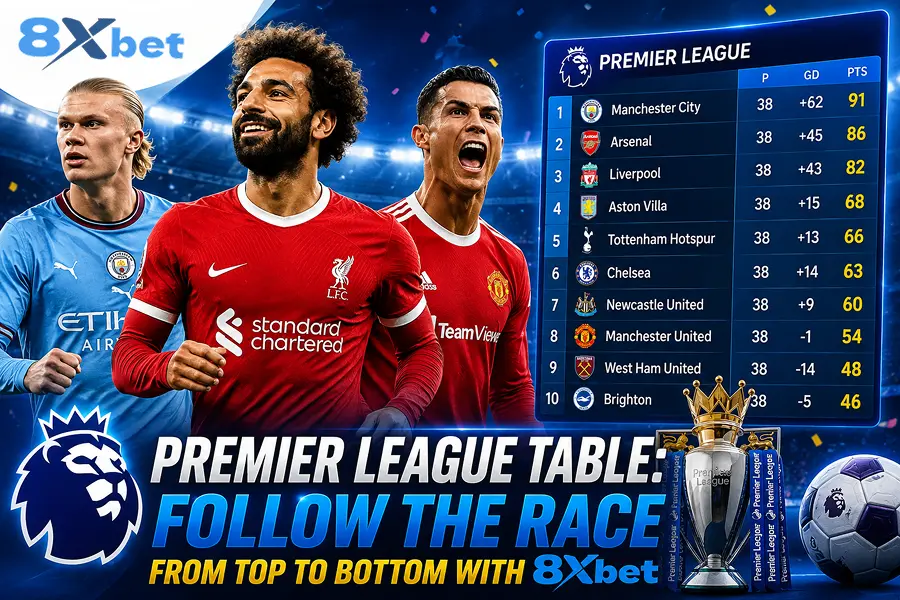
A Premier League table can look straightforward at first glance: twenty clubs, a column of numbers, and one team sitting above everyone else. Looking closer, the table tells several stories at once.
One club may be chasing the title while another is fighting for a Champions League place. A few positions lower, two teams separated by a single point could be heading in completely different directions. Down at the bottom, one victory can suddenly make a relegation battle look very different.
The English Premier League has 20 clubs, with each team playing the other 19 home and away for 38 matches. A win earns three points, a draw earns one, and a defeat earns none. However, points alone don’t tell you everything worth knowing.
Understanding the Premier League table means knowing how to read the numbers, recognising what each position represents, and putting the standings alongside the fixtures still to come.
The Premier League Table Never Tells Just One Story
League position gets most of the attention, but several columns explain how a club arrived at that position. If you’re relatively new to following the Premier League, these are the abbreviations you’ll regularly encounter:
| Abbreviation | Meaning | What It Shows |
| P/PL | Played | Number of league matches completed |
| W | Won | Matches the club has won |
| D | Drawn | Matches ending level |
| L | Lost | Matches the club has lost |
| GF | Goals For | Goals scored by the club |
| GA | Goals Against | Goals conceded |
| GD | Goal Difference | Goals scored minus goals conceded |
| Pts | Points | Total league points accumulated |
The last column attracts the eye first because points determine the standings’ basic order. Yet the other figures provide context.
Consider two clubs sitting close together. One may have scored considerably more goals, but conceded more, too. Another could have fewer wins but remain competitive because it rarely loses. Reading across the table can tell you considerably more than looking at the position number alone.
Premier League or Nigeria Premier Football League? Know Which Table You’re Reading
For Nigerian football fans, the word Premier League can occasionally need a little context. In this guide, the Premier League table refers to the English Premier League, the 20-team English top flight featuring clubs such as Arsenal, Liverpool, Manchester City, and Chelsea.
Nigeria has its own top-flight competition: the Nigeria Premier Football League (NPFL). So, if you’re searching for Nigeria Premier League standings or Nigeria Premier Football League standings, you’re looking for the NPFL table rather than the English Premier League standings discussed here. The competitions are separate, even though both use a league-table format to track clubs across the season.
For football followers using 8xbet Nigeria, keeping that distinction in mind also makes it easier to find the league, fixtures, or matches you’re actually interested in.
Three Points at the Top Can Feel Very Different From Three at the Bottom
Every Premier League victory is worth three points. Its significance isn’t always the same. A win for the league leaders could open a gap over their closest title rival.
Three points for a club around fourth or fifth might transform the race for European qualification. At the opposite end, one victory could lift a struggling side out of the relegation places. The table, therefore, becomes increasingly interesting when you read teams in relation to those immediately around them.
A six-point difference might look comfortable in October. With three matches remaining in May, the same gap becomes far more significant because there are fewer opportunities left to close it.
Context changes as the season moves. The mathematics doesn’t.
A Game in Hand Is an Opportunity, Not Three Points
Here’s one of the easiest mistakes to make when reading the standings. Suppose Chelsea has 52 points from 30 matches while Manchester United has 49 from 29. Chelsea are three points ahead, but United have a game in hand.
It can be tempting to award United the three points and call them level mentally. Yet the outstanding fixture still has to be played, and won. A draw would add only one point, while a defeat would add nothing.
Games played should therefore be one of the first columns you check when comparing teams.
This becomes particularly important when postponements, cup commitments, or scheduling differences temporarily leave clubs with unequal numbers of matches. The Premier League table shows what teams have earned, not what they might earn later.
Level on Points? Goal Difference Enters the Conversation
Two clubs can finish with the same points total, so the Premier League needs a way to separate them. Goal difference comes first. Subtract the number of goals a club has conceded from the number it has scored.
A team with 60 goals scored and 40 conceded has a goal difference of +20. If two clubs finish level on points, the one with the superior goal difference ranks higher. Should goal difference also be identical, goals scored become the next criterion.
Further tiebreakers include points earned in head-to-head matches and then away goals scored in those meetings. Goal difference isn’t merely a technical footnote either. Manchester City famously won the 2011/12 Premier League title over Manchester United after both finished on 89 points, with City’s superior goal difference deciding the championship.
Sometimes every goal really does count.
The Top of the Table Is About More Than First Place
Naturally, first place has the simplest reward: get to finish there after 38 matches, and you’re Premier League champion. Immediately below the champions, another contest develops as league position plays a major role in determining qualification for UEFA competitions, including the Champions League, Europa League, and Conference League. The precise number of qualifying positions can vary depending on England’s UEFA allocation and results in domestic and European competitions.
For that reason, assuming that a particular position will always lead to the same European competition can be misleading. Check the qualification picture for the relevant season. It also explains why the battle around the upper positions can remain compelling even after the title has been decided. One club may already know it cannot finish first, yet still have plenty at stake in the final weekends.
At the Bottom, the Numbers Become Uncomfortable
The other end of the standings has a much simpler cut-off. Teams in 18th, 19th, or 20th position are relegated from the Premier League to the EFL Championship. Three promoted Championship clubs replace the relegated sides for the following season.
However, this is where small margins can become enormous. Imagine 17th place has 35 points and 18th has 34 with two games remaining. One result could completely reverse their positions.
Interestingly, you’ll sometimes hear supporters talk about the magical “40-point mark” for survival. It isn’t an official threshold. In fact, Premier League analysis published during the 2025/26 season noted that the club finishing 18th had averaged 35.2 points since the competition became a 20-team league.
Survival depends on finishing above the bottom three, not reaching an arbitrary number.
Don’t Read the Table Without Checking the Fixtures
A league table is a snapshot. Fixtures provide some of the missing context. Suppose two points separate two clubs with four matches left. Club A still has to face several sides competing near the top, while Club B’s remaining opponents occupy lower positions.
The table alone won’t show that difference. Recent form adds another layer. A side sitting seventh after three consecutive victories may carry very different momentum from a sixth-placed team that hasn’t won in five. However, neither fixture difficulty nor form guarantees what happens next.
Football regularly makes predictions look foolish. Use them to understand the standings, not to pretend the next result is already known.
From the Premier League Table to the Match on 8xbet Nigeria
For football followers using 8xbet Nigeria, standings can provide useful context before looking at an upcoming Premier League fixture. Start with the teams themselves and question these:
- Where do they currently sit?
- How many matches have they played?
- What’s the points difference between them?
- Check recent results and whether either side is involved in the title race, European qualification battle, or fight against relegation.
- Then move to the actual fixture.
The 8xbet football section can be used to view Premier League matches and the betting markets currently available on the platform. Don’t assume league position alone predicts the result. A first-placed team isn’t automatically guaranteed to beat the club in 15th.
Home and away performance, injuries, team selection, scheduling, and current form can all change the picture.
Following a Premier League match? Check the standings first, then visit 8xbet Nigeria to see the fixture and football markets currently available.
The Table Changes How You Read the Next Fixture
Consider a late-season match between fourth and fifth. In isolation, it is simply another Premier League fixture. Now imagine only one point separates the teams. Suddenly, the match carries direct consequences for their positions. A victory could create separation, while a draw may benefit another club chasing them from sixth.
The same applies near the bottom. A fixture between the 17th and 18th can become particularly significant because both clubs aren’t merely trying to collect points; they’re denying a direct rival the opportunity to collect them. This is why standings and fixtures work best together; the fixture tells you who is playing, while the table helps explain why the match matters.
Don’t Turn the Table Into a Betting Prediction
League position is useful information, but it isn’t a betting system. The club in third can lose to the team in 14th. A side with an excellent goal difference can concede first. A team struggling away from home can still produce its best performance of the season.
More importantly, historical results don’t guarantee future ones. If you’re using the Premier League table before checking a football market on 8xbet, treat the standings as one piece of information rather than proof of what will happen.
The distinction matters. A table records what has already happened. Betting concerns an outcome that hasn’t happened yet.
38 Games Later, the Table Gets the Final Word
Throughout a Premier League season, the standings constantly move. A Saturday victory can push a club three places higher before Sunday’s matches knock it back down. Goal difference can separate rivals. Games in hand create possibilities. Winning and losing streaks reshape title, European, and relegation races.
Eventually, however, everyone reaches 38 matches. At that point, possibilities become final positions. For anyone following English football on 8xbet Nigeria, checking the table alongside upcoming fixtures can provide useful context for the matches you’re interested in. Just remember what the numbers can, and cannot, tell you.
The Premier League table explains where every club stands. The next match decides whether it stays there.
Premier League Table FAQs
How does the Premier League table work?
Clubs are ranked primarily by the points they’ve earned. A victory earns three points, a draw one, and a defeat zero. Each of the 20 teams plays 38 league matches during the season.
What does GD mean in the Premier League table?
GD means goal difference. It is calculated by subtracting goals conceded from goals scored. For example, 50 goals scored and 35 conceded produce a +15 goal difference.
What happens if two Premier League teams have the same points?
Goal difference separates them first, followed by goals scored. If further separation is required for final positions, head-to-head points and away goals in those matches are considered, with a neutral-venue playoff possible in certain consequential ties if all preceding criteria remain equal.
How many Premier League teams are relegated?
Three. The clubs finishing 18th, 19th, and 20th are relegated to the Championship at the end of the season.
Does a game in hand mean a team has three extra points?
No. A game in hand only means the club has played one fewer fixture than the team you’re comparing it with. It receives three points only if it wins that outstanding match.
Can I follow Premier League fixtures on 8xbet Nigeria?
Check 8xbet Nigeria for the English Premier League fixtures and football markets currently offered by the platform. Using the standings alongside fixtures can provide context, but league position should never be treated as a guarantee of a future result.